
Accredited testing scope
ISO/IEC 17025
ARE Labs is accredited for its current testing scope. Request the certificate and scope to confirm coverage for your study.
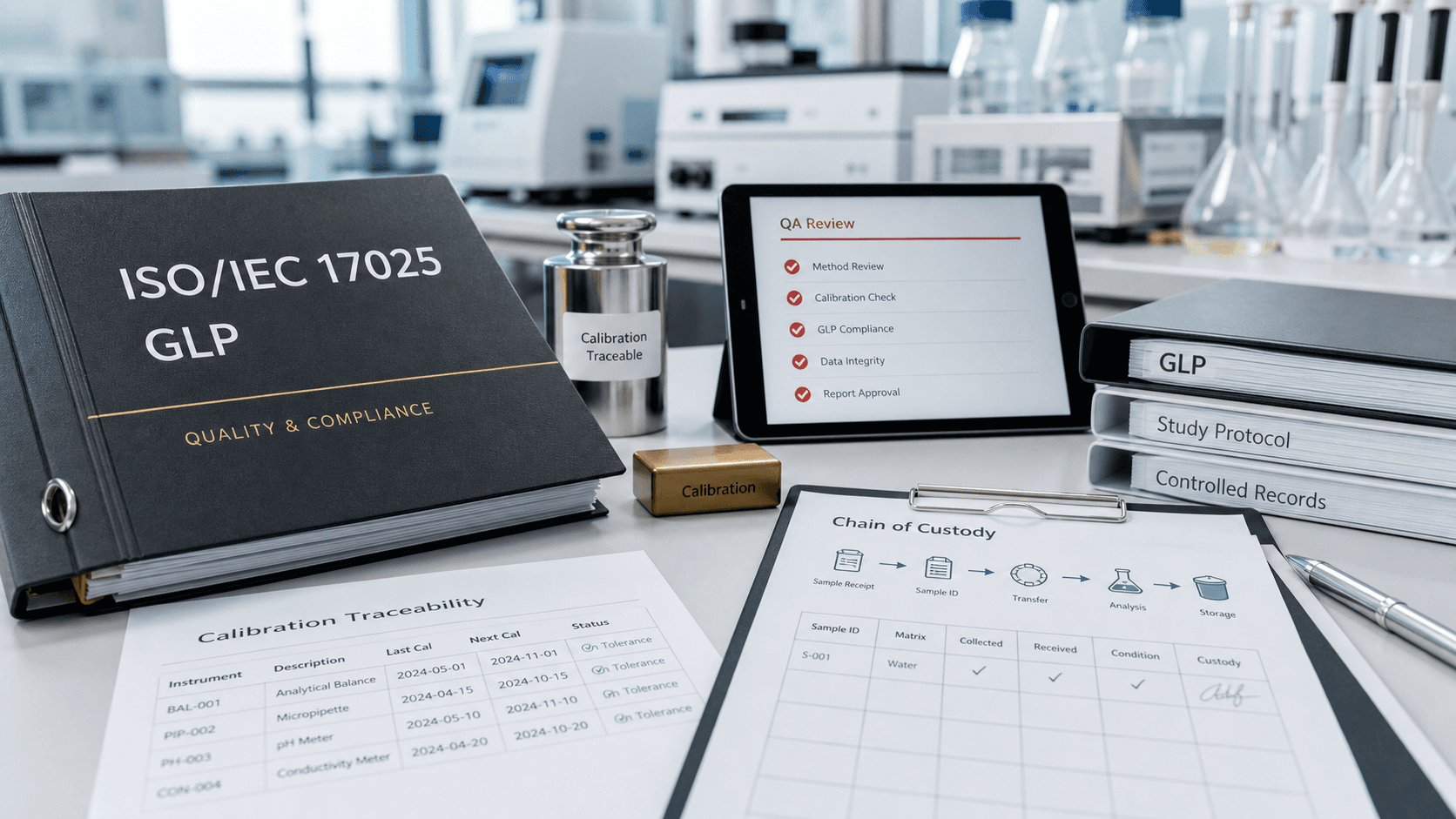
Quality documentation connects ISO/IEC 17025 accreditation, GLP documentation options, and calibration records to the scope of a study.
ARE Labs completed its first on-site U.S. EPA FIFRA GLP inspection and selected study audit in August 2026. That independent regulatory oversight complements an ISO/IEC 17025-accredited testing scope and documented controls for protocols, instruments, calibration, records, and reporting.
ARE Labs completed a U.S. EPA FIFRA GLP inspection in August 2026 and maintains ISO/IEC 17025 accreditation for its current testing scope.
Review ARE Labs' accreditation scope, authorizations, inspection history, and study-quality documentation.
ARE Labs maintains ISO/IEC 17025 accreditation for its current scope of testing. The accreditation addresses laboratory competence and the quality-system controls used for activities listed in the current certificate and scope.
The accredited scope includes particle sizing, plume geometry, spray pattern, bioaerosol testing, VOC testing, and cascade impactor testing and analysis.
Certificate details, scope coverage, and method status should be checked against the current certificate and scope. Methods outside that scope are described as standards-aligned or custom protocol work.
ARE Labs maintains DEA Schedule I analytical and research authorization for its current registered scope. Before a study is accepted, the applicable substance schedule, protocol, storage, handling, and documentation requirements are confirmed against current authorization records.
ARE Labs completed its first on-site U.S. EPA FIFRA GLP facility inspection and selected study audit under 40 CFR Part 160 in August 2026.
On-site facility inspection and selected study audit completed. This record describes a regulatory inspection; it does not imply EPA certification or endorsement.
Kansas Board of Pharmacy licensing supports eligible analytical and research activities conducted by ARE Labs in Kansas. Project-specific applicability is confirmed against current license documentation before work involving controlled substances is scoped.
Reported measurements are connected to identified instruments, calibration and service records, equipment status, and the conditions documented for the study. Traceability statements remain bounded by the records and instruments used for that work.
The study record can include the approved protocol, raw data, instrument records, chain-of-custody where applicable, deviations, quality assurance review, and report review. The documentation retained for a project follows its agreed scope and applicable quality requirements.
| No. | Authority | License / registration | Study applicability |
|---|---|---|---|
| 01 | U.S. Drug Enforcement Administration | DEA Schedule I analytical and research license / registration for the current authorized scope. | Current authorization, substance schedules, storage, handling, and protocol limits are verified through current documentation before a study is scoped. |
| 02 | Kansas Board of Pharmacy | Kansas Board of Pharmacy analytical and researcher license / registration for the current authorized scope. | State licensing supports eligible analytical and research activities in Kansas; project-specific applicability is confirmed against current license documentation. |
| No. | Control | What it supports | Study applicability |
|---|---|---|---|
| 01 | Standard operating procedures (SOPs) | Define how recurring tasks, instruments, and study steps are performed and recorded. | SOPs support repeatable practice and the accredited quality system; they do not make every custom study externally accredited. |
| 02 | Documented protocols | Define study scope, setup, measurements, controls, and reportable outputs. | Claims are tied to the documented protocol and agreed study scope. |
| 03 | Instrument records | Connect reported measurements to named instruments and study conditions. | Measurement statements stay tied to the instruments and conditions used in the study. |
| 04 | Calibration traceability | Supports confidence in instruments and measurement records. | Traceability statements are tied to available calibration and instrument records. |
| 05 | Chain-of-custody | Tracks sample handling and identity through the study where applicable. | Applied where sample handling and identity matter to the study question. |
| 06 | Deviations and technical review | Support raw-data review, deviation handling, and reporting discipline within the study. | GLP controls under 40 CFR Part 160 are applied to applicable FIFRA studies; other studies use the controls defined in their protocols. |
Studies are run to applicable methods where the protocol calls for them, with the standard referenced by name in the study record. Standards alignment describes method context and does not by itself imply that every named standard is inside the accredited scope or that a product has been certified by an external body.
For applicable FIFRA studies, ARE Labs applies GLP controls under 40 CFR Part 160: protocol control, raw-data capture and review, instrument and calibration records, deviation handling, quality assurance review, and a reviewable study record from setup through final report.
ARE Labs has provided GLP study reports for FDA submissions for more than 15 years.
For other studies, the same documentation disciplines can be scoped when they improve clarity and defensibility. GLP is a regulatory study framework rather than a product certification, and the applicable requirements are defined for each study.
These official references provide public context for ISO/IEC 17025 accreditation, aerosol science, nonclinical study documentation, and GLP discussions. They do not imply approval, endorsement, or affiliation.
For documentation questions, ask for the current ISO/IEC 17025 certificate, DEA Schedule I analytical/research authorization, Kansas Board of Pharmacy analytical/researcher license documentation, or records that apply to a specific study or protocol.


