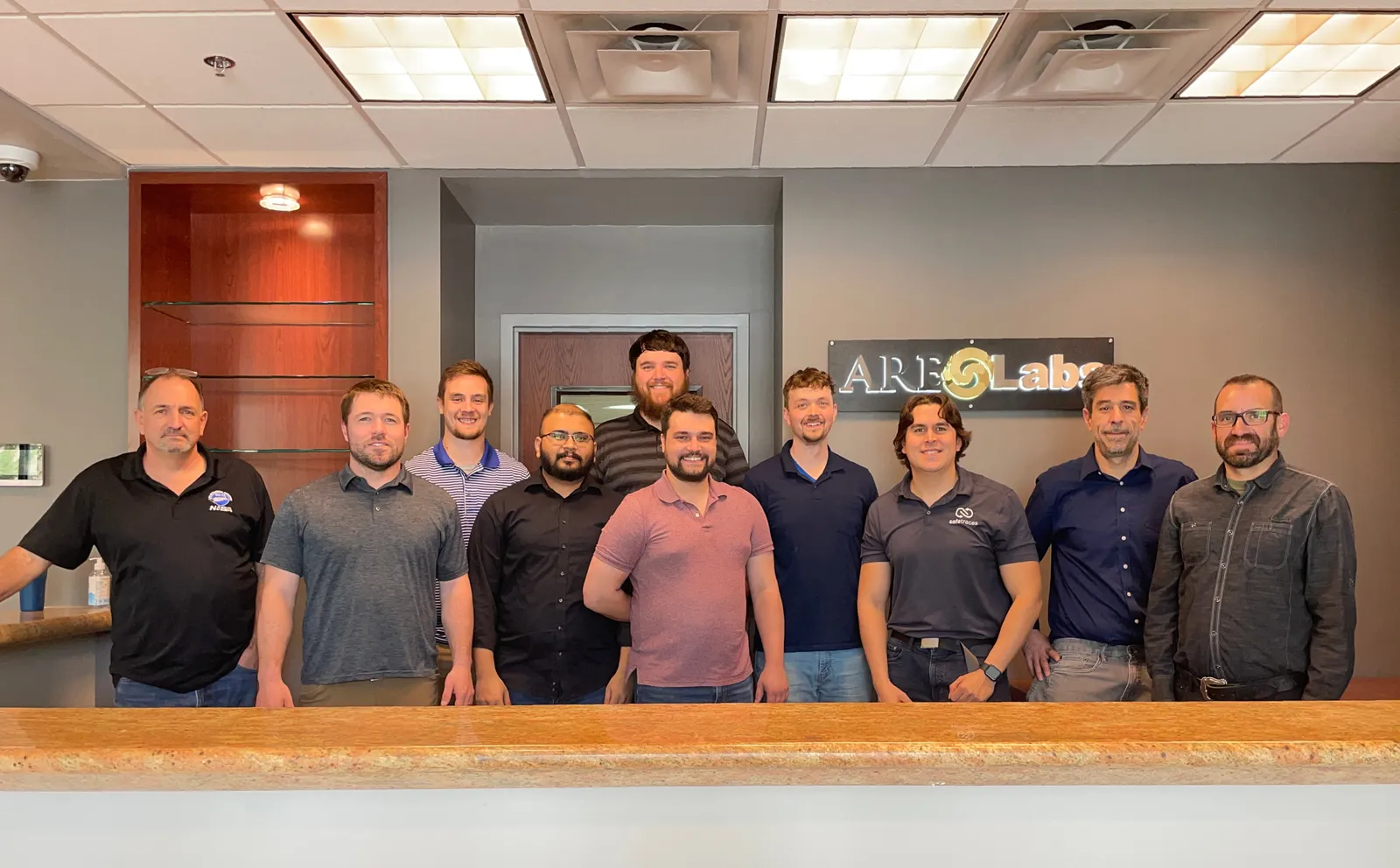
ARE Labs team group photo in the lobby with the company sign
ARE Labs

ARE Labs team group photo in the reception lobby with the company sign, 2024.

People

Meet the Team

ARE Labs work depends on six role groups — aerosol scientists, bioaerosol and microbiology specialists, pharmaceutical and formulation staff, engineers and builders, QA and technical review, and inhalation toxicology staff — collaborating around a defined study question.

Team content for ARE Labs, including role groups, working style, technical culture, and how staff collaborate around defined study questions.

Six role groupsAerosol and bioaerosol sciencePharmaceutical and formulationEngineers and Custom Build ShopQA and technical review
Management

Management team

ARE Labs' management team is accountable for company direction, laboratory operations, and technical judgment across complex aerosol programs.

Portrait slot for Jamie Balarashti
Founder & Chief Scientific Officer

Jamie Balarashti

Founded ARE Labs in March 2009 and sets scientific direction across complex aerosol programs. His work anchors the company around practical aerosol science, custom study design, and careful interpretation of what a test can support.

Focus: Scientific direction, aerosol program design, complex study review

Portrait slot for Weston Schaper
President

Weston Schaper

Leads the company and its R&D direction, with a particular focus on pharmaceutical aerosol work. His background across chemistry, biology, and medical training helps connect formulation questions, measurement limits, and client decision needs.

Focus: Company leadership, R&D, pharmaceutical aerosol programs

Portrait slot for Richard Ludwick
Director of Operations

Richard Ludwick

Oversees day-to-day laboratory operations and program execution. With more than 40 years in R&D and a chemical-engineering foundation, he keeps custom setups, laboratory resources, and delivery realities aligned with the study plan.

Focus: Laboratory operations, program execution, custom setup coordination

Role groups

Why role groups are listed

Role groups show how ARE Labs assembles the right technical mix for a study. They are not staff cards or departments to browse; they explain why one program may need aerosol science, microbiology, formulation, engineering, inhalation, and QA judgment in the same record.

Role group

Aerosol scientists

Translate the client question into measurable aerosol, particle, plume, spray, or inhalation conditions.

Method fit, measurement strategy, aerosol generation, sizing, sampling, and interpretation.

Role group

Bioaerosol and microbiology specialists

Keep biological-aerosol studies controlled around organism handling, challenge design, and recovery.

BSL-2 practice, viable sampling, organism context, neutralization, controls, and recovery review.

Role group

Pharmaceutical and formulation staff

Connect respiratory-device, formulation, chemistry, and in-vitro performance questions.

Dry-powder, nasal, inhalation, HPLC, stability, characterization, and method alignment.

Role group

Engineers and builders

Make the physical test system match the protocol when a stock setup cannot answer the question.

Custom fixtures, chambers, enclosures, device actuation, timing controls, and build-shop support.

Role group

QA and technical review

Keep the final record traceable to the work actually performed and the claims the protocol supports.

Protocols, records, calibration traceability, deviations, data review, and report boundaries.

Role group

Inhalation toxicology staff

Support exposure-system work where chamber setup, flow paths, and in-vitro inhalation context matter.

Exposure chambers, ventilated mannequins, inhalation setup review, and study-specific controls.

Working model

How a study moves through the team

Custom studies move through a practical sequence: scoping, assembling the right technical roles, documented execution, and final review.

  1. 01

    Scope the question

    Management and technical staff clarify the decision, samples, material constraints, target conditions, method options, and claim boundaries before the protocol is locked.

  2. 02

    Build the path

    The right role groups assemble around the study: aerosol science, biology, formulation, engineering, QA, inhalation, or custom build support as needed.

  3. 03

    Run and document

    Execution stays tied to the protocol through instrument records, setup notes, environmental context, controls, deviations, and raw-data capture.

  4. 04

    Review the record

    Technical and QA review keep conclusions inside the evidence, so the final report supports the client decision without overstating what the study showed.

Next

Continue from the team into the workplace or laboratory.

Move next to Careers for workplace context or Facilities for the laboratory spaces behind the work.