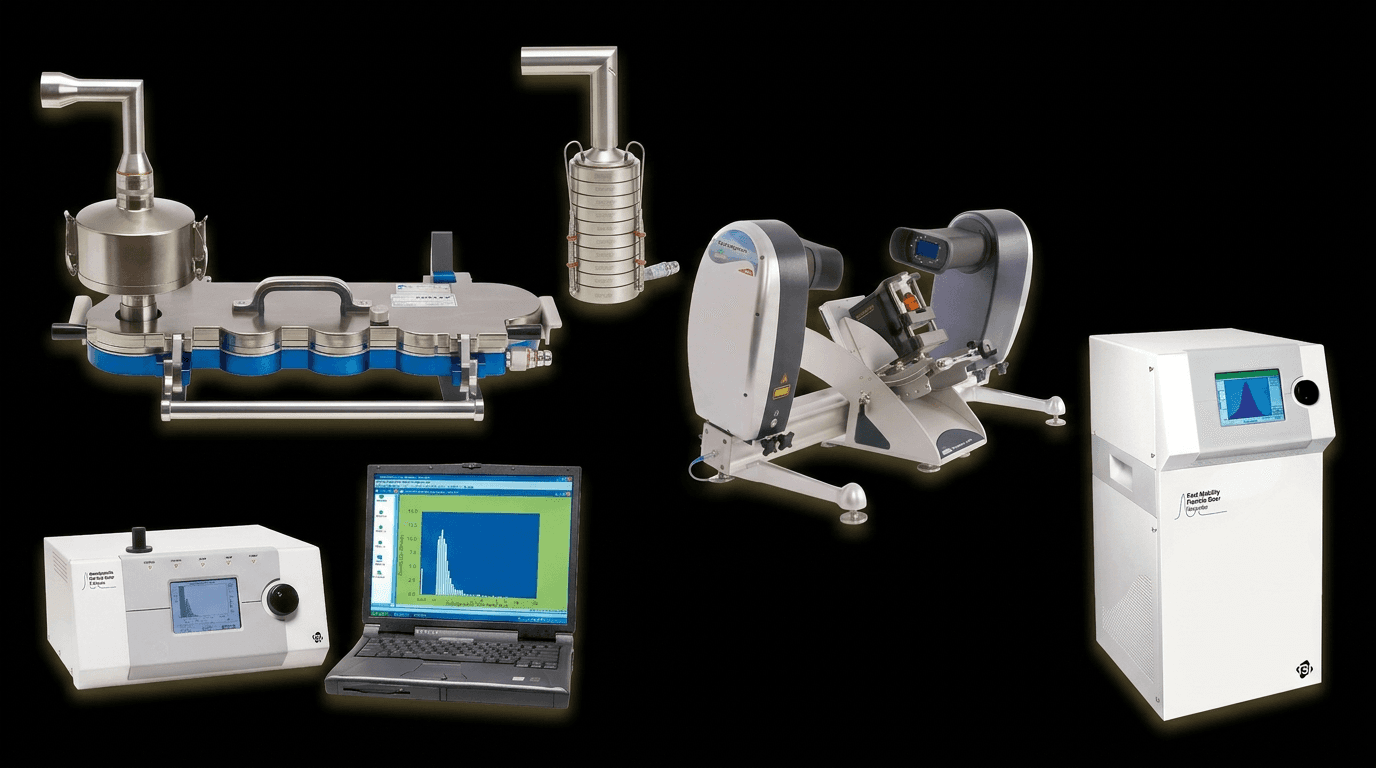
Particle Size Distribution (PSD) testing measures how aerosol mass and number distribute across particle diameters. Size distribution helps explain how a drug, antimicrobial, or consumer aerosol behaves in the lung, on a surface, or through a filter. For applicable inhalation products, cascade impactors (NGI, Andersen) provide regulator-aligned mass profiles for MMAD and GSD under USP <601>. Real-time platforms (APS, OPS, FMPS, Spraytec) add time-resolved sizing and droplet spectra. PSD supports:
- PSD for MDIs, DPIs, nebulizers, and nasal sprays — stage-by-stage mass, MMAD / GSD, and fine-particle dose for in vitro packages under USP <601>, USP <1601>, FDA MDI / DPI / nasal.
- Lot-to-lot and design-change studies compare nozzle, valve, formulation, propellant, or pump changes under a defined protocol; ISO 17025 quality records document reference products, replicates, and method controls.
- Exposure and risk assessments for consumer aerosols, antimicrobial sprays, and room-applied disinfectants — fine-fraction and ultrafine particle screening informing EPA inhalation-safety dossiers and OECD test-guideline alignment.
- Stability and accelerated-aging studies where particle-size drift is a critical quality attribute under USP <601>, ICH Q1A, and FDA stability guidance — supporting shelf-life justifications and container-closure decisions for inhalation products.
- Fogging, misting, and ULV (ultra-low volume) droplet-spectrum characterization for room-disinfection and antimicrobial-spray applications, supporting EPA registration programs where applicable, with aerosol sizing and sampling defined by the study protocol.
Use PSD testing when you need size-fraction data traceable to a defined method setup. We control actuation, flow, and conditioning and document replicates, blanks, and analytical controls from collection through reporting. This documentation supports review of the results for internal decisions, predicate comparison, or regulatory submission.